After an absence of almost twenty years, artist Everlyn Nicodemus is making a triumphant return to Brussels with a retrospective exhibition at Wiels. Black Bird shows how, for over four decades, she has transformed her experiences of racism, trauma, and oppression into poetic imagery, with a special focus on her experimental Brussels period.
The journey of Everlyn Nicodemus is yet more proof that perseverance pays off.
Also in:
en
nl
The journey of Everlyn Nicodemus is yet more proof that perseverance pays off. Born in Tanzania in 1954, the artist was only “discovered” a few years ago by London gallerist Richard Saltoun while she was working in a care home to pay the bills. Since then, she has enjoyed international acclaim. She feels no bitterness about having to wait so long, she assures us from her home in Edinburgh, Scotland. “I'm also an art historian, so I'm all too aware that female artists are often only appreciated long after their death, and for black women, that holds even more true. I feel fortunate that the recognition has come while I'm still here. It also shows that the art world is changing: the door is no longer completely shut.”
Before her major breakthrough, Nicodemus had exhibited her work several times, the first time being 45 years ago in her native Tanzania. She had only just found her calling after visiting European museums following a move to Sweden. “It was a shock to see the great variety of art by African artists in those museums. I hadn't had any artistic training, but I discovered art then as a way to express myself. I worked with whatever materials I could find, such as barkcloth or plywood.”
"I'm also an art historian, so I'm all too aware that female artists are often only appreciated long after their death, and for black women, that holds even more true"
Artist
From the very beginning, Nicodemus, who is also a poet, used her visual work and its poetic imagery to reflect on the impact of racism, trauma, and oppression – an impact she experienced first-hand upon her arrival in Europe. “Before that, racism was an abstract concept to me, but in Sweden it became a reality. I had to deal with insults, discrimination, and descriptions of black people as inferior – as animals, even. My work is partly about myself, but I also look much more broadly. For example, at how women in general are so often silenced.” Her work pushes back against this through a bold and playful use of colour, texture, and form: art as an act of freedom and a space for healing.
In that early period, the 1980s, she was particularly active as a painter. The retrospective Black Bird at Wiels, which follows an initial presentation at the National Galleries of Scotland, illustrates this productivity with paintings from the pivotal series Women in the World, based on interviews about what it means to be a woman that Nicodemus conducted in Denmark, Tanzania, and India.

Everlyn Nicodemus: "Before that, racism was an abstract concept to me, but in Sweden it became a reality. I had to deal with insults, discrimination, and descriptions of black people as inferior – as animals, even."
A key difference between Black Bird and the earlier Scottish exhibition is the special attention given to the artist's time in Brussels, where she lived near Flagey from the late 1990s until 2008. She moved to the capital after a decade in Borgerhout, Antwerp, where she created the series Silent Strength and The Wedding following a nervous breakdown. Nicodemus looks back on her time in Elsene/Ixelles with pleasure. “I felt more freedom there; I found a liberal-minded community and an international environment. They were my best years in Belgium.” In terms of art, Bozar was an anchor point. “I rarely missed an exhibition there. So when I had the chance to take part in a show there myself, it was very special.”
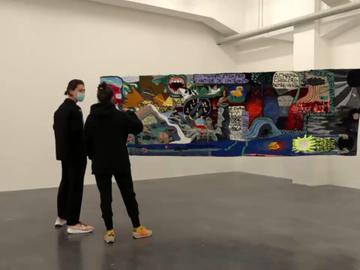
During her time in Belgium, Nicodemus also exhibited in other institutions and galleries, with the artistic high point being her solo exhibition Crossing the Void at CC Strombeek. There, she showed the seminal work Reference Scroll on Genocide, Massacres and Ethnic Cleansing, made in Brussels. It is a sixteen-metre-long paper scroll on which she documented genocides and ethnic cleansings throughout history, such as that carried out by German soldiers in present-day Namibia at the beginning of the twentieth century. It is a powerful – and devastatingly current – work that will have a prominent place in the Wiels exhibition.

Everlyn Nicodemus: "In Ixelles I felt more freedom; I found a liberal-minded community and an international environment. They were my best years in Belgium."
The Reference Scroll is a fine example of the experimental phase Nicodemus was in while in Brussels, a period that is highlighted here more than it was in Scotland. Painting faded into the background as she began to focus more on textiles, paper, collage, and her so-called “internetting” works. For these latter creations, she encased personal and found objects – sourced from the flea market in the Marolles – in a “cage” or “prison” made of metal wire.
In Brussels, Nicodemus was also very active as a writer. She wrote a yet-to-be-published book about her artistic quest, also titled Black Bird, and was the sole editor of the African section of an influential international survey on the history of modern art outside the West. In 2008, a PhD opportunity prompted her to leave Belgium for the United Kingdom. She has now lived in Edinburgh for many years, where she continues to expand her body of work.
Nicodemus has recently returned to painting after a hiatus of more than twenty years. In the series Lazarus Jacaranda, she reflects on, among other things, her battle with cancer, which is sadly still ongoing. Her artistic activities, she stresses, are what keep her going. “Without my creative work, I wouldn't be sitting here talking to you. Art is my medicine, it protects me from despair.”
Everlyn Nicodemus's solo show Black Bird runs from 25/10/2025 to 1/2/2025 at Wiels, wiels.org
Read more about: Vorst , Expo , Everlyn Nicodemus , Tanzania , Vorst , kunstenares