At Bozar, the game-changing exhibition When We See Us celebrates one hundred years of black joy in African and diaspora painting. Two artists and a gallerist from Brussels choose one painting from among the 180 works exhibited and share their impressions on the beauty of the everyday they convey.
©
Tiffany Alfonseca
| Tiffany Alfonseca (b.1994, New York City, USA) Espero que ya le dijiste a tu madre de nosotras 2020 Acryl, glitter, olieverf en houtskool op doek Courtesy of Jorge M. Pérez Collection, Miami
Also read: Streamingkanon Patrick Watson na de stemproblemen: 'Of je blijft zwemmen, of je verdrinkt'
The exhibition When We See Us celebrates the power of painting by exploring the best things life has to offer: joy, parties, community, love, sexuality, spirituality, etc. It is full of uplifting themes that are nonetheless political and liberating. This travelling exhibition, which is stopping off at Bozar, brings together work by 120 black artists from Africa and elsewhere, who, from 1920 to today, have painted their own as they saw them, and as they saw themselves.
When We See Us, which originated in the monumental Zeitz MOCAA, the museum of contemporary art in Cape Town, first caused a stir in South Africa. Behind this ambitious project is Koyo Kouoh, the Cameroonian curator and director of the museum since 2019. A key figure of the global art scene, she was recently appointed as a director of the 2026 Venice Biennale.
In an interview with the New York Times in August 2023, Kouoh said: “African culture has often been defined by others in so many wrong ways. I don't believe we need to spend time correcting those narratives. We need to inscribe other perspectives.”
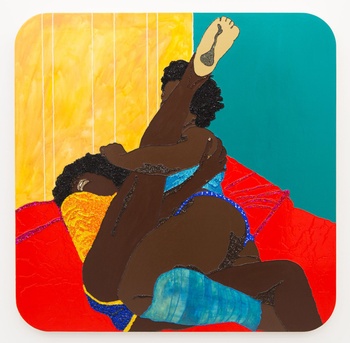
That guiding inspiration is shared by Marie Gomis, the director of the online gallery of the same name, which represents a few of the most popular names in international Afro-descendant photography. Along with two other figures from the Brussels art scene, BRUZZ invited Marie Gomis to choose a piece from When We See Us and share her impressions of it. She selected a painting by the US artist Mickalene Thomas, famous for her bold treatment of the sensuality of women, particularly black women.
As for Collyns Charts, an emerging young painter who studied at La Cambre, he chose a piece by Jacob Lawrence. This painter from the US, who died in 2000, is known for his visual descriptions of the African American experience. “Jacob Lawrence led the way for painters like me,” says Charts, whose exciting figurative paintings are currently represented by Wetsi Gallery in Etterbeek (and will be shown there during an exhibition programmed from 10/4 to 10/5). Directed by Wetsi Mpoma, this gallery, the first of its kind in Belgium, shines a light on the creativity of Afro-descendant artists.
Finally, Victoria Okoka W'ekanga, an equally groundbreaking young painter, chose a piece by the Tanzanian artist Sungi Mlengeya. Currently exhibiting her project Vie intérieure at the KVS, Okoka explains why this painting resonates so deeply with her: “It is as if it validated my own experience.”
Marie Gomis
Gallerist and curator

©
Sophie Soukias
| Marie Gomis
©
© ARS, NY AND DACS, LONDON 2022
| Marie Gomis: “Thomas captures something both beautiful and profoundly human”
“Since she started out, I have been following the painter and photographer Mickalene Thomas (born in 1971, ed.), a key figure of the contemporary art world. The first time I saw her work in person, it was at Galerie Nathalie Obadia in Brussels, then at the Musée Picasso in Paris, and I also follow her closely on social media. Featured in the most illustrious collections in the US, at the intersection of art and fashion, she has even collaborated with Dior to design a bag. Young, audacious, and ultra trendy, Mickalene Thomas is, in my view, one of the major artists of our time.”
“In Never Change Lovers in the Middle of the Night from 2006, what fascinates me is her audacious way of exploring black and queer femininity. Her mixed-media technique (rhinestones, enamel, acrylic on wood panels) is her true signature, offering an incredible visual richness that can only be fully appreciated when you are physically standing in front of the piece. I urge readers to pay a visit to Bozar to see it.”
“The painting shows two naked female bodies, lying stretched out with sensuality and assurance. Mickalene Thomas reinvents the codes of Western classical nudes by placing black women in them, proud and confident, far from rigid exoticised stereotypes. She celebrates the richness of the black identity and the complexity of bodies. I love how she plays with light shining, the very dark skin tones, and the glistening aesthetic that adds a layer of sensuality to the piece.”
“This painting also tells a story. The title, borrowed from a song by Millie Jackson, covered by Boney M., evokes the 1970s and the vitality of black popular culture at that time. Echoes of the Black Power movement and slogans such as 'black is beautiful' and 'I'm black and I'm proud' can be found in her work. The retro disco aspect makes her work even more powerful.”
“I also like her way of dealing with sexuality face-on. In this piece, two women are making love and, while that may seem subversive, she captures something both beautiful and profoundly human.”
Collyns Charts
Painter

©
Sophie Soukias
| Collyns Charts

©
THE JACOB AND GWENDOLYN KNIGHT LAWRENCE FOUNDATION,SEATTLE/ARTISTS RIGHTS SOCIETY (ARS), NEW YORK AND DACS, LONDON 2022
| Collyns Charts: “Lawrence taught me how to show what connects us despite our differences”
“Jacob Lawrence (1917-2000, ed.) was a pioneer of Afro-descendant painting in the US, and I can say that his work profoundly influenced how I paint. In his painting The Card Game from 1953, figures play cards around a table. This scene of togetherness touched me on the deepest level. The fact that they are almost 'trapped' in what looks like a sheet evoked several things for me: I see in it a nod of the head to European art, the works of Cézanne for example, but also a profound connection to black culture, and to my own family memories, the games of cards that we played together.”
“And then, there are the colours: the blue, the red, a very vibrant red that invades almost half the canvas. It creates a warm atmosphere, and you feel like you are invited to enter into the intimate space with the figures. It is precisely that invitation to discover a culture, while still maintaining a sober aesthetic, which compels me in my own work. I like the idea that my viewers feel that they are being welcomed into worlds that they are not necessarily familiar with.”
“What strikes me in particular about Lawrence's work is his ability to tackle political questions without ever letting politics dominate his art. It is a very difficult balance to achieve, and it is the reason his work is still so relevant today. He was able to document reality with great sensitivity, without violence, while capturing the essence of the black condition and the struggle for civil rights in the US. His approach to colour taught me a lot. He taught me how to capture the essence of things, how to show what connects us despite our differences. After all, we have all played a game of cards with someone before, haven't we?”
“From the beginning of my studies, I asked myself what an artist of my generation could still say about their environment and their culture. By comparing my work to that of Lawrence, I realise that the question of black belonging had not yet been resolved in his day. His art reflects the evolution of such questions. To me it seems that, although the issue is not entirely resolved, progress has been made and fortunately art is now more open to Afro-descendant voices, thanks to artists like him in fact. The same commitment is present in my own work, but it is more subtle.”
“I spent my whole life surrounded by white people, whether at boarding school or at school, but I was never forbidden from expressing my culture. It came to me naturally to want to represent Afro-descendant people. Over time, after mixing with members of the diaspora – artists, musicians, poets, and writers of my generation – I realised that it comes from within you: to make art drawn from this culture is to participate in a collective memory, a journey that began with artists like Jacob Lawrence.”
Victoria Okoka W'ekanga
Painter and draughtswoman

©
Sophie Soukias
| Victoria Okoka W'ekanga

©
Courtesy of Afriart Gallery
| Victoria Okoka W'ekanga: “Sungi Mlengeya's painting is a marked departure from dehumanising clichés”
“This painting, Constant III from 2019, by the self-taught Tanzanian artist Sungi Mlengeya (born in 1991, ed.) resonates profoundly with me. It shows the relationship between a big sister and a little sister, a tie based on guidance and protection. In the black community, young girls face demands related to appearance, success, and behaviour, and a big sister can be a source of guidance through those challenges."
"Here, the big sister exudes serene confidence, not seeking the approval of the viewer, her diverted gaze affirming her independence. There is a kind of requirement to represent Afro-descendant people as strong and resilient women. It's a reductive view that makes me uneasy in general, but I am forced to admit that it is true. Faced with the microaggressions we experience in everyday life, we have no choice but to be strong. My own sister gave me the confidence necessary to access spaces that seemed inaccessible, helping me to navigate disappointments in love, problems at school, and the affirmation of my identity as a black woman.”
“She also showed me that I did not have to choose between my cultures. In a family rooted in Congolese tradition, she found a balance between here and elsewhere, which encouraged me to draw inspiration from all my influences without shame. She went in search of her own models in magazines and on the internet, such as Beyoncé, an iconic figure who opened up new horizons to her in music, fashion, and art. I followed that path, finding my own niches online and constructing my vision of the world from those fragments.”
“To come back to Sungi Mlengeya's painting, I was also struck by the contrast between the pure white of the background, which melds with the clothing, and the depth of the dark complexions. The figures, though they are not looking at each other, are nonetheless intimately connected, just like my sister and me. I like this depiction, which is a marked departure from the dehumanising clichés too often associated with the history of slavery. To be black is also to live a rich existence full of nuance and emotion.”
“My relationship with painting followed the same path. As a child, I would draw white figures, influenced by my environment. The first portrait I did of a black person, my mother, when I was still in nursery school, was a turning point: that was when I became conscious of my black identity. At age twelve, I started to create Afrocentric figures, and in 2022, I took up painting again with renewed intensity. It became a space in which my individuality found its place, a way of overcoming the discomfort of struggling with self-affirmation. Through my work, I hope to show that it is possible to change your inner trajectory and to feel yourself flourish completely.”
Read more about: Expo , When We See Us , Bozar , Koyo Kouoh , Black painting , modern art


